The most important practical information for a trip to Germany: concise, practical, and including tips on planning, accommodation, transportation, money, health, and regulations. As of April 2026. Regulations are subject to change; be sure to check official sources for additional information on visas, customs, insurance, transportation, and cannabis before your trip.
Contents
Practical travel information
These tips will help you get ready for your trip and while you're on the go, especially if this is your first time traveling to Germany.
Barrier-free travel
Compared to other countries, Germany is well-prepared for accessible travel in many areas. Nevertheless, it’s worth planning carefully, as train stations, accommodations, historic city centers, and rural areas can vary greatly in terms of accessibility.
- When traveling by train, check Deutsche Bahn’s mobility service well in advance.
- For vacation planning, germany.travel provides information on accessible travel destinations.
- For accommodations, ask for specific details: steps, elevator, bathroom, door widths and parking space.
Best time to travel
Germany is generally a great place to visit all year round. However, spending time outdoors is more pleasant from March through October than during the cold winter months.
- May, June and September are often particularly pleasant: mild to warm weather, long days and less crowds than in the main holiday season.
- July and August are warm and popular, but also the vacation season with higher prices and more activity, especially on the coasts, lakes and in the Alps.
- December is good for Christmas markets, short city trips and a wintry atmosphere.
- January to March are more suitable for museums, cities and winter sports regions; the weather can be gray, wet or cold.
- Book accommodation early for Oktoberfest, major trade fairs, public holidays and school vacations.
Climate
Germany has a temperate climate with four distinct seasons. The weather can vary significantly from region to region and from year to year.
- Summers are usually mild to warm, with individual hot days above 30 degrees Celsius.
- Winters in the lowlands are often rather wet and gray; snow is possible there, but rather rare.
- The North and Baltic Seas are windier and somewhat more maritime, while winters in Saxony and the Alpine region are colder and snowier.
- Rain is possible all year round; a light rain jacket or umbrella is almost always worthwhile.
- For active travel in spring and fall, pack clothing in layers.
Hotels & special accommodations
Germany has hotels in almost every price range, from simple guesthouses to wellness and boutique hotels.
- Bed and breakfasts and guesthouses are often smaller and more personal than hotels.
- Half board usually means breakfast plus dinner; full board means breakfast, lunch and dinner.
- A valid ID is required at check-in (usually from 4 p.m.) (also at hostels etc.).
- You can also find unique accommodations in castles, manor houses, or historic buildings; good places to start are germany.travel, regional websites such as Romantische Rhein, and hotel chains such as Romantik Castle Hotels.
Cheaper accommodation
If you want to travel on a budget, hostels, vacation rentals, or rooms rented by private individuals are often good alternatives to hotels.
- Hostels in cities are usually more relaxed, often have dormitories and are suitable for cooking for yourself or meeting new people.
- Vacation apartments and Airbnb are also inexpensive options. In the Alps, DAV huts are a good option for hiking fans.
- Shared rooms and furnished apartments are suitable for longer stays.
- Youth hostels are often well-organized and a good option for groups.
- Booking early and comparing online saves money.
- In addition to online platforms, local tourist information offices can sometimes also help with last-minute accommodation
Camping
Camping is most pleasant from May through early September. For camping trips, nighttime temperatures should be above 10 degrees Celsius.
- Book campsites in popular regions early in the high season.
- In the low season, check whether the sanitary facilities and reception are open.
- Outside of designated campsites, wild camping is prohibited with a few exceptions.
- Depending on the type of trip, a Camping Card International can offer discounts or additional benefits.
Savings opportunities
Many discounts aren't automatically applied. It's worth actively showing your ID or discount cards, or asking about discounts before making a purchase.
- An ISIC card and student ID can get you discounts at museums, on public transportation, for guided tours, and at tourist attractions.
- Airbnb, hostels and campsites are often cheaper than hotels.
- Pensioners and disabled people can also often get discounts with the appropriate ID.
- Many cities offer guest cards or city cards with public transport and discounts. Good if you are planning to visit lots of attractions.
- Drink tap water.
- Use ride-sharing services like BlaBlaCar, long-distance buses like FlixBus, or affordable train deals.
- Shop at discount stores (Aldi, Penny, Lidl,...) instead of supermarkets (EDEKA, Rewe,...).
Book tickets in advance
For some very popular attractions and events, it’s worth making a reservation in advance, even if admission is sometimes free. Especially during holiday seasons, on weekends, and in bad weather, time slots fill up quickly.
- The Reichstag Dome in Berlin: free admission, but advance registration and ID check are required.
- Neuschwanstein Castle: Interior tours are only available as scheduled guided tours; be sure to book early, especially in the summer.
- Miniatur Wunderland in Hamburg: Booking a time slot often helps avoid long wait times.
- Popular museums and palaces: e.g., the Green Vault in Dresden, guided tours of Sanssouci, or major special exhibitions.
- Viewpoints and concerts: Be sure to check in advance for the Berlin TV Tower, Elbphilharmonie concerts, and popular shows.
- Major events: Soccer games, Oktoberfest tents, carnival grandstands, festivals, and special Christmas market tours can sell out quickly.
Power plug
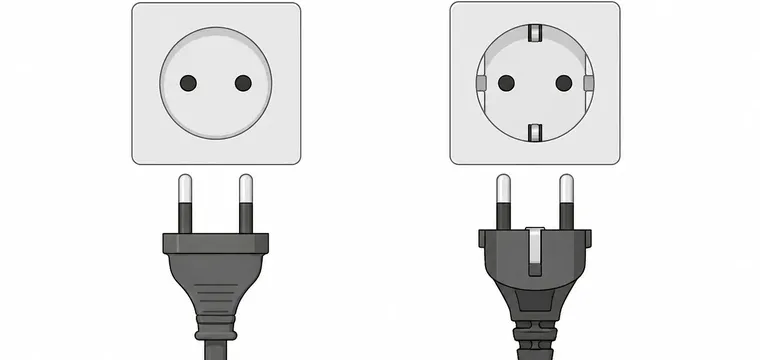
Germany uses 230 volts at 50 hertz. Type C and Type F plugs are standard.
- Many European two-pin plugs fit, but travelers from Great Britain, Ireland, the USA, Canada, Australia and many other countries usually need an adapter.
- Before traveling, check whether appliances support 230 V.
Telephone & Internet
The international dialing code for Germany is +49. When calling from abroad, you should usually omit the leading 0 from the German area code or mobile number.
- Example: 030 becomes +49 30 internationally.
- EU roaming is uncomplicated for many travelers from EU countries.
- You can often buy prepaid SIMs at the airport, in mobile phone stores, electronics stores, supermarkets or kiosks.
- In Germany, an identity check is required for activation, usually with a passport or ID card via Video-Ident, Post-Ident or directly in the store.
- As a foreign guest, it is often easiest to make a purchase in a mobile phone store because identity verification is supported there directly.
Time zone
Germany is in the Central European Time zone. Central European Summer Time is observed in the summer.
- Winter time: CET / UTC+1.
- Summer time: CEST / UTC+2.
- The changeover usually takes place on the last Sunday in March and the last Sunday in October.
- When it is 6:00 a.m. in Berlin in summer, it is 5:00 a.m. (-1 h) in London, 0:00 a.m. (-6 h) in New York and 12:00 a.m. (+6 h) in Beijing.
Customs & allowances
Different rules apply to alcohol, tobacco, medications, fuel, cash, and goods, depending on the country of origin. Especially if you are entering from a non-EU country, you should check the official duty-free allowances set by German customs before your trip. As of April 2026.
- From non-EU countries: 200 cigarettes or 100 cigarillos or 50 cigars or 250 g of tobacco, provided you are at least 17 years old.
- From non-EU countries: 1 liter of spirits over 22% or 2 liters of alcohol up to 22%, plus 4 liters of non-sparkling wine and 16 liters of beer.
- Other goods, e.g. souvenirs or jewelry: up to 430 euros for air and sea travel, up to 300 euros for entry by land; 175 euros for travelers under 15 years of age.
- Cash of 10,000 euros or more must be declared in writing when entering the country from a non-EU country.
- Within the EU, other, usually significantly higher guideline quantities apply to privately brought alcohol and tobacco.
Transportation
Germany has excellent transportation links within Europe: by train, car, long-distance bus, and plane, and in many cities, it is also easy to get around by bike and public transit. The most important rules vary depending on the mode of transportation.
Borders & Schengen
Germany shares borders with nine countries and is part of the Schengen Area. There are generally no traditional border controls at land borders, as is the case at many external borders, but temporary controls may be implemented.
- Nevertheless, always take your ID or passport with you.
- There are security checks at airports; passport controls depend on whether you are entering from the Schengen area or from outside.
- Police or customs checks can very rarely be carried out on buses, trains or cars, even within Germany.
Everyday traffic
Many traffic rules are similar to those in other European countries, but in everyday life, the "right-of-way" rule, bicycle traffic, traffic light rules, and emergency lanes are particularly important.
- At intersections without signs or traffic lights, right before left applies.
- Pay particular attention to cyclists and pedestrians when turning.
- Turning right on red is only permitted if there is a sign with a green arrow and you also stop beforehand or check particularly carefully.
- Form an emergency lane in traffic jams on highways and multi-lane roads.
- Do not pick up your cell phone or cigarette while driving; set the navigation beforehand or use the hands-free system.
Flight
For international travel, Frankfurt am Main, Munich, and Berlin Brandenburg are the main arrival points. Depending on your destination, however, Düsseldorf, Hamburg, Cologne/Bonn, Stuttgart, Hanover, Nuremberg, or Leipzig/Halle may also be convenient.
- Frankfurt and Munich are the largest German hubs.
- Many airports are well connected by S-Bahn, regional train or long-distance train; check travel times, especially for early flights.
Airports
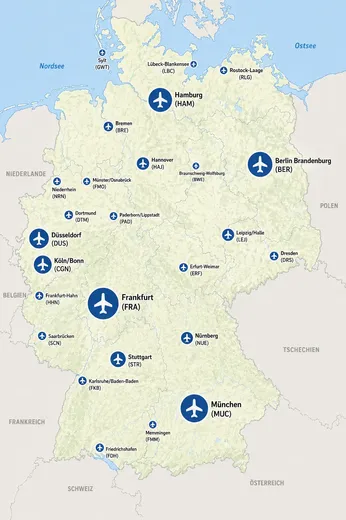
Overview of the largest airports in Germany.
Rail & public transportation
Germany has a very extensive rail network. For longer distances, there are ICE, IC, and EC trains. Regional service is provided by RE, RB, and S-Bahn trains; in cities, the subway, tram, and bus are also available. You can find train schedules on bahn.com or via the DB Navigator app.
- In addition to Deutsche Bahn, private providers such as ODEG, Metronom, National Express or Länderbahn also operate; many connections are nevertheless integrated into the DB search.
- Punctuality in long-distance transport is a frequent point of criticism: in 2025, only around 60 percent of DB long-distance trains reached their destination on time.
- ICE, IC and EC are long-distance services; different tickets apply for these than for local services.
- Seat reservations are often optional for long-distance travel, but make sense for long journeys, vacation periods and weekends.
- 1. Class is significantly more expensive and usually not necessary for normal travel.
- Buy tickets before the start of the journey, online, in the app, at the ticket machine or at the travel center; tickets are not normally available on the train.
- Observe validation obligations if paper or strip cards are still available on site.
- There are often no ticket checks at the entrances, but sporadic ticket checks on the trains.
Train tickets & rail offers
For long-distance trains, it’s almost always worth booking early because discounted fares are limited. For regional travel, day passes and group tickets can be cheaper than single tickets.
- The inexpensive Deutschlandticket is valid throughout Germany on local trains, but not on ICE, IC or EC trains. It is a subscription ticket.
- Country tickets are usually valid for one day on regional trains and often on S-Bahn trains within a federal state or region, often for up to 5 people.
- Many regional tickets are only valid from 9 a.m. on weekdays, but often all day on weekends and public holidays; check details for each federal state.
- The Quer-durchs-Land ticket is valid throughout Germany on regional trains and S-Bahn trains, for up to 5 people, from 9 a.m. on weekdays and all day on weekends/holidays.
- Children up to the age of 5 travel free of charge and usually do not have to be specified; children from 6 to 14 travel free of charge on many DB offers, but must be entered when booking.
- A BahnCard 25 or BahnCard 50 is worthwhile for frequent use; there are attractive My BahnCard offers for young travelers under 27.
- The German Rail Pass can be interesting for travelers residing outside Germany if they are planning several train journeys in a short period of time.
Night trains & Rail Passes
Night trains are a good option for travel to Austria, Italy, Switzerland, Belgium, Poland, Hungary, or Croatia. Many traditional night trains are now operated by ÖBB Nightjet or partner railways; DB also offers select ICE/IC night services.
- Book sleeper and couchette coaches early, as cheap seats can sell out quickly.
- Reservations or surcharges may be necessary for Rail Passes such as the German Rail Pass, Interrail or Eurail.
Ferries
Ferries are particularly useful for travel to Scandinavia, the Baltic States, and various islands. Major ferry ports include Kiel, Travemünde, Rostock, Sassnitz/Mukran on Rügen, and other ports on the North Sea and Baltic Sea.
- Kiel and Travemünde are important starting points for Scandinavia.
- Rostock and Sassnitz/Mukran on Rügen are relevant for Baltic Sea connections.
- You don't need a ferry for the islands of Rügen, Sylt and Fehmarn, but you do for most of the North Sea islands.
Roads & Driving
Germany has a dense road network with good connections to neighboring countries and within the country. Traffic drives on the right. There is no general toll for standard passenger cars on German highways; tolls apply primarily to trucks.
- In urban areas, the speed limit is usually 50 km/h without any other signage.
- Out of town, the speed limit for cars is often 100 km/h unless otherwise indicated.
- The following applies on highways: If no speed limit is displayed, there is no fixed maximum speed for cars; 130 km/h is then the recommended speed.
- Slower vehicles keep to the right; the left lane is mainly for overtaking.
- Overtaking is always on the left.
- In many cities, environmental badges are required for driving in environmental zones, otherwise you could be fined.
Driver's license, insurance & mandatory equipment
If you plan to drive or rent a car in Germany, check in advance to see if your driver’s license is valid there. For short tourist stays, a valid foreign driver’s license is often sufficient; however, depending on your country of origin, an international driver’s license or a translation may still be required or very helpful.
- Driver's license, vehicle documents and proof of insurance must be available for inspection.
- In the event of breakdowns, automobile clubs such as the ADAC or a cover letter from your own insurance company can help; some foreign automobile clubs have partner agreements.
- Rental cars in Germany often have manual transmission; automatic transmission should be booked deliberately.
- Minimum age, valid driver's license, credit card and deposit are usually required for rental cars.
- Well-known providers include Hertz, Europcar, Sixt, Avis and Enterprise.
- A safety vest, warning triangle and first aid kit must be present in the car.
- Seat belts must be worn in all seats in the car.
- Children up to the age of 12 or under 1.50 m need a suitable child seat.
- Suitable winter tires are mandatory in winter road conditions.
- Helmets are compulsory for motorcyclists and passengers.
Environmental badge
Many German cities have low-emission zones. If you want to drive into these zones or park there, you need to display the appropriate emissions sticker on your windshield. This also applies to vehicles with foreign license plates.
- The environmental badge is not required for entry into Germany, but for designated environmental zones in which air pollution is to be reduced.
- A green sticker is practically required in most environmental zones. The car must meet certain emission standards in order to obtain a green sticker.
- You can obtain the sticker with the vehicle documents from registration offices, TÜV, DEKRA or many garages, for example.
- In the case of rental cars in Germany, the sticker is usually already present; in the case of rental cars from abroad or your own car, check beforehand.
- Without a valid sticker or exemption permit, you may be fined in low emission zones.
Refueling & rental car damage
Fueling up in Germany is straightforward, but it is often significantly more expensive on highways than in cities or industrial areas. Fuel prices are displayed per liter.
- The usual fuels are petrol, Super E10, Super Plus and diesel; check beforehand which fuel your car needs.
- Many filling stations work like this: fill up first, then name the pump in the store and pay.
- Take detailed photos of the rental car on handover and return, including the rims, glass, roof edge and interior.
- Even small dents or scratches can be expensive or cause a dispute; check the insurance, excess and protocol carefully.
Cabs & transport services
Taxis are convenient, but they tend to be expensive in Germany. They’re easy to find in cities, at train stations, airports, and larger hotels; in smaller towns, it’s best to book in advance. Fares are regulated, but they vary depending on the city or county.
- Official cabs are usually light beige and have a cab sign on the roof.
- The price is normally calculated using the taximeter; fixed prices or prices quoted in advance may be possible for apps, airport transfers or certain routes.
- Card payment is often possible, but not always a matter of course; ask before starting your journey.
- FREENOW, formerly mytaxi, is a popular cab app.
- Uber is available in some cities and can be cheaper; in Germany, however, licensed cab or rental car companies drive rather than private drivers as in some countries.
- Apps and transport services (e.g. Moia in Hamburg and Hanover) may be available depending on the city, but not everywhere.
Bicycle
Many German cities have good cycling infrastructure, but the quality and safety vary greatly. There is no general helmet requirement for cyclists, but wearing a helmet is recommended.
- Bicycles need functioning brakes, bells, lights and reflectors.
- Cycle paths must be used if they are signposted accordingly.
- On country roads, bicycles usually ride on the normal road if there is no cycle path.
- Bicycles are subject to traffic rules such as right of way, traffic lights and right before left.
- Be careful with streetcar rails, especially if the rails are wet or at an angle.
- Depending on the train, transport association and federal state, taking bicycles on trains, subway or regional transport costs extra or is limited in time.
Buses, long-distance buses & carpooling
Long-distance buses are often cheaper than trains or planes, but they take longer and are more dependent on traffic conditions. Local buses, on the other hand, are part of the respective public transit system; fares, apps, and rules vary by city or region.
- FlixBus is the best-known long-distance bus company in Germany.
- Central bus stations are often located near the main station; in Berlin, however, the ZOB is located at the Funkturm/Messedamm and not at the main station.
- The Romantic Road Coach may be of interest for sightseeing tours.
- Depending on the route, international routes can also be operated by other providers.
- Carpooling services like BlaBlaCar are a good option if the times and meeting spots work out.
Money, opening hours & everyday life
Many everyday things in Germany are straightforward, but they can sometimes come as a surprise to travelers: cash is still important, Sundays are quiet, and business hours vary greatly depending on the location and industry.
Money & Cash
The currency in Germany is the euro. Card payments have become more common, but some small restaurants, bakeries, snack bars, and market stalls still insist on cash.
- It still makes sense to have some cash with you.
- Visa and Mastercard are accepted in many places; American Express much less frequently.
- Debit cards often work well, but not every international debit card is accepted everywhere.
- The German Girocard is sometimes more readily accepted in small stores than credit cards.
- Maestro is being phased out; older Maestro cards may still work, but are no longer future-proof.
- Before ordering, briefly check whether the card is accepted.
- Tipping is voluntary and is often rounded up when paying or given in cash.
Withdraw money
You can find ATMs at banks, shopping malls, and train stations. You can also often withdraw cash for free at the checkout counter in supermarkets, drugstores, and some gas stations when making a purchase.
- Cashback at the checkout usually only works from a minimum purchase and often only with certain cards.
- ATMs are often cheaper than independent machines in tourist locations.
- Always check fees and exchange rates before confirming.
- Your own bank may charge additional fees for foreign cards.
Credit cards & exchange rates
Visa and Mastercard are accepted at many hotels, larger stores, train stations, and restaurants. However, some smaller businesses only accept Girocard or cash. You should keep an eye on exchange rates before your trip and when making card payments.
- When paying by card, settle in euros, not in the home currency, if the exchange rate offered is unfavorable.
- The European Central Bank publishes euro reference rates for informational purposes.
- Bureaux de change are available at airports and train stations, among other places, but they may have less favorable exchange rates or fees.
Usual opening hours
Business hours vary. In large cities, many places stay open later than in rural areas. On Sundays, supermarkets, most stores, post offices, and banks are usually closed.
- Discounters often open between 7 a.m. and 8 p.m., while supermarkets are usually open longer.
- Restaurants are often open between 11 a.m. and 11 p.m., with breaks or days off depending on the establishment.
- Bars usually start in the evening, clubs often only from around 11 pm.
- Banks, small grocery stores and post offices usually have shorter opening hours than supermarkets.
Post & Stamps
You can send letters and postcards through Deutsche Post. Stamps are available online, at post offices, many parcel shops, and sometimes at newsstands or stationery stores.
- Postage rates may change from time to time; please check the current rates with Deutsche Post before shipping.
- Status 2026: Postcard within Germany 0.95 Euro.
- Status 2026: Postcard international, i.e. Europe and worldwide, 1.25 euros.
Vacations & Holidays
School breaks and public holidays in Germany vary by state. This affects prices, availability, traffic, and business hours, especially in the summer, on long weekends, and around Christmas.
- Check school vacation schedules before booking, especially for family destinations and coastal regions; the KMK publishes school vacation schedules by state.
- Stores are usually closed on public holidays, bakeries may be partially open in the mornings.
- Public holidays also vary by state; this website, for example, provides an overview.
- Schools in all federal states have Christmas, New Year and Easter off. There are also 6 weeks of summer vacation, but at different times so that not everyone travels at the same time.
Security
Overall, Germany is a safe place to travel. The most common problems travelers face are not serious crimes, but rather theft, lost valuables, aggressive cyclists, or accidentally purchasing the wrong train ticket.
Pickpocketing
Pickpocketing is particularly common in places where large crowds gather or people are distracted. These include train stations, subways and commuter trains, shopping malls, bars, clubs, Christmas markets, festivals, and tourist hotspots.
- Carry valuables close to your body and close your pockets.
- Do not leave cell phones and wallets visible on tables.
- Pay particular attention in crowds and when getting on and off the bus.
Hostels & lockers
Many hostels provide lockers, but a lock isn't always included. It's handy to have your own small padlock, especially in dorms.
- Lock up valuables or carry them with you.
- Save digital copies of important documents separately (in the cloud or mailbox).
Station district, Bars & Clubs
In some larger cities, areas around train stations are lively but also rougher. Drug use, fraud, theft, and aggressive behavior are more common there. You should also keep an eye on your drinks in bars and clubs.
- At night it is better to use busy routes and take a cab or public transport if you feel unwell.
- Do not leave drinks unattended.
- Contact staff or police in case of problems.
Keep cycle paths clear
In Germany, bike lanes are often part of regular traffic and are heavily used. Anyone who stands or walks on them risks dangerous situations and annoyed cyclists ringing their bells.
- Watch out for red or marked cycle lanes.
- Look for bicycles when getting off the bus, streetcar or cab.
- Pay particular attention in cities like Berlin, Hamburg, Münster or Freiburg.
Everyday life, language, entry & work
This section covers topics that aren't directly related to housing, money, or health, but quickly become important once you're there: restrooms, communication, entry requirements, registration, work, and volunteering.
Toilets
Public restrooms in Germany are not always free. In restaurants, cafés, or bakeries, restrooms are usually intended for customers; sometimes a small fee is charged there as well. This may seem unusual to some travelers, but it’s also because cleaning and maintenance have to be paid for.
- There are simple free toilets on highways, but they are not always clean.
- Sanifair or service area toilets often cost around 50 cents to 1 euro; there is often a voucher.
- Have small change or card ready.
- In most private households, men are also expected to urinate sitting down!
Languages
The official language is German. English is widely spoken, especially in tourist areas, larger cities, hotels, and among younger people, but it is not spoken everywhere.
- Regional dialects can be strong, for example in Bavaria, Saxony or the Palatinate.
- Sorbian is spoken in parts of Saxony and Brandenburg.
- Danish is spoken in Schleswig-Holstein, Frisian on the North Sea coast and Romani is spoken by some Sinti and Roma.
- The spread of many regional minority languages has declined sharply.
Entry & Visas
Entry requirements depend on your nationality, the length of your stay, and the purpose of your trip. Different rules apply to short-term tourist visits than to visits for work, study, au pair placements, or longer stays.
- EU, EEA and Swiss nationals can enter the country without a visa and require a valid passport or identity card; the document should be valid for at least the duration of the entry and stay.
- Many third-country nationals, including travelers from the United Kingdom, the USA, Canada, Australia, Israel, Japan and New Zealand, can often travel visa-free to the Schengen area for short tourist stays of up to 90 days within a 180-day period.
- Other nationalities often require a Schengen visa in advance.
- If you move into an apartment in Germany, you normally have to register your place of residence with the Bürgeramt; this is usually not relevant for pure hotel or short stays.
- Always officially check passport validity and entry requirements before traveling.
Volunteering
Volunteering can be a great way to get to know Germany better and for a longer period of time. Legally, however, not all unpaid work is automatically permitted, especially when accommodation, meals, or spending money are involved.
- Clarify beforehand whether a visa, residence permit or work permit is required.
- Programs and platforms such as GoAbroad, Transitions Abroad or specialized volunteer service providers can serve as a starting point for your research.
- Au pair stays have their own rules, age limits, language skills and contract requirements.
- Reputable providers are transparent about costs, insurance, working hours, accommodation and contact persons.
Working in Germany
Citizens of the EU, the EEA, and Switzerland generally have free access to the German labor market. For many other nationals, a residence permit and work permit are required.
- Before starting work, non-EU citizens should check whether their residence permit allows them to carry out the specific activity.
- Tourist stays do not normally permit gainful employment.
- Internships, au pairs, mini-jobs or paid volunteering may also be subject to approval.
Health, Pharmacies & Insurance
The German healthcare system is well-developed. However, the type of insurance travelers have is crucial.
Visit to the doctor & costs
People who have public health insurance in Germany (or who use the EHIC as EU/EEA travelers) do not pay out of pocket for many doctor’s visits, as the costs are billed directly to their health insurance provider.
- EU/EEA citizens can often use the EHIC (European Health Insurance Card) and are treated similarly to those with statutory health insurance.
- Travelers with private or international health insurance, on the other hand, often have to pay medical costs themselves first and submit them later. The type of cover therefore determines whether the costs are settled directly via a health insurance fund or whether you have to pay in advance.
- Keep your insurance card, insurance number and ID card or passport to hand.
- If you have private international health insurance, check beforehand whether the insurance company will pay directly or whether you will pay yourself first and then apply for reimbursement later.
- Keep invoices, prescriptions, payment receipts and medical reports.
International health insurance
International health insurance is especially important if your regular health insurance in Germany does not apply, or applies only to a limited extent. Be sure to consider not only medical expenses, but also emergency medical services, repatriation, and exclusions.
- Check whether return transportation and rescue costs are covered.
- Note exclusions for certain sports, outdoor activities or pre-existing conditions.
- Save the insurance emergency number offline.
- Keep your insurance number to hand.
Pharmacies & Medicines
In Germany, many medications are available only at pharmacies, and many of them require a prescription. Drugstores mainly sell personal care products, dietary supplements, and a few over-the-counter health products, but they do not carry typical prescription medications such as many pain relievers or cold remedies.
- There is an emergency pharmacy service outside normal opening hours.
- Carry a sufficient supply of regularly required medication and, if necessary, a doctor's certificate.
- Pharmacies can also help with minor complaints or questions about medication, but they are not doctors' surgeries.
Further insurances
In addition to health insurance, depending on the type of trip, liability, trip cancellation, or baggage insurance may also be a good idea. Personal liability insurance, in particular, can be important if you accidentally cause damage.
- Check liability insurance, especially for longer stays.
- Travel cancellation insurance can be useful for expensive trips.
- Also back up important documents digitally, for example in an email account or a cloud.
Internet access & WLAN
Wi-Fi is available in many hotels, cafés, libraries, train stations, and tourist facilities. However, the quality varies, and sometimes you have to sign up.
- Do not use public WLANs for sensitive logins without additional protective measures.
- Hotspot directories such as hotspot-locations.com can help with the search.
- An eSIM or prepaid SIM is worthwhile for longer trips if your roaming is expensive.
Legal Matters
Some rules are particularly important for travelers because violations can quickly become costly or jeopardize insurance coverage. You should verify the details with official sources before your trip.
Alcohol & driving
In Germany, the legal blood alcohol limit for most drivers is 0.5 �
- Drinking and driving can result in fines, points, a driving ban and insurance problems.
- Driving with a blood alcohol level of 0.5 or more is prohibited, but it is also prohibited at lower levels if you are driving unsafely or cause an accident.
- In the event of an accident or conspicuous driving, even low values can become relevant.
- One beer (0.5 l) leads to approx. 0.3-0.5 per mille, depending on weight and gender.
Cannabis & other drugs
The use of cannabis is no longer generally a criminal offense for adults in Germany, but the rules are complex. Legal does not mean that purchasing, importing, or using cannabis anywhere—or driving while under the influence—is without consequences. Legal access is severely restricted for tourists.
- Do not import cannabis across borders into Germany.
- Consumption in the vicinity of schools, playgrounds and certain public places is restricted.
- The THC limit for driving is 3.5 ng/ml in the blood serum; mixed consumption with alcohol is prohibited.
- Practical safety distance: it is better not to consume for at least 24 hours before driving; THC can be detectable for longer with regular consumption.
- Other drugs remain illegal.
Smoking
In Germany, the protection of non-smokers is primarily the responsibility of the federal states. In many restaurants, public buildings, public transportation, and train station areas, smoking is prohibited or permitted only in designated areas.
- Pay attention to signs and designated smoking areas.
- Rules may vary depending on the federal state and type of locality.
- E-cigarettes can also be covered by house rules or smoking bans.
- Unfortunately, people still smoke in many clubs and bars.
- Smoking is still widespread in Germany: Around 20-25% of adults smoke regularly.
Drones
Strict regulations apply to drones in Germany and the EU. Depending on the drone’s weight, camera, location, and intended use, registration, identification, proof of competence, insurance, or a permit may be required.
- Drone liability insurance is a key issue in Germany and should be clarified before the flight.
- Do not fly near airports, crowds, places of use or sensitive areas.
- Check official charts and rules before the flight.
Fishing
In Germany, fishing is only permitted with a fishing license (similar to a driver's license).
- Some federal states (e.g. Mecklenburg-Western Pomerania, Schleswig-Holstein) offer tourist or short-term fishing licenses
- In addition, you always need a permit for the specific body of water you want to fish.
- Ask the local fishing club, tourist information office or the responsible authority.
- Catch-and-release can also be legally problematic.
- Observe closed seasons and minimum sizes.
Traffic rules & speed limits
Speed checks are common in Germany, even in built-up areas and on rural roads. On highways, there are stretches without a general speed limit, but many sections have fixed or variable limits.
- The speed limit in urban areas is usually 50 km/h, but often also 30 km/h.
- Outside built-up areas, 100 km/h often applies if nothing else is signposted.
- The following applies on highways: If no speed limit is displayed, there is no fixed maximum speed for cars; 130 km/h is then only the recommended speed.
- If you are driving slower, keep to the right as far as possible; the left lane is primarily intended for overtaking.
- Overtaking is always on the left.
- It is forbidden to pick up your cell phone while driving; set the navigation before starting the journey or use the hands-free system.
LGBTIQ+ travel
Homosexuality is not a criminal offense in Germany, and same-sex couples can marry. Many cities have a visible queer scene, particularly Berlin, Cologne, Hamburg, and Munich. At the same time, reports of anti-LGBTQ+ attacks have recently become more frequent; most recently, these have also targeted gay men in popular nightlife districts, near train stations, or during fake dates arranged through apps. The perpetrators are often politically right-wing or Islamist in orientation.
- Same-sex marriage is permitted in Germany.
- Large cities are usually more visible and better connected.
- For app dates, pay attention to public meeting places, your own gut feeling and a trusted person.
- In the event of discrimination or violence, contact the police or counseling centers.
Fun facts about Germany
A few surprising facts and stories that make for a nice, light-hearted conclusion.
Castles, cathedral & language
Germany is full of historical superlatives, but not every figure is equally easy to measure.
- Depending on how you count, there are around 20,000 to 25,000 castles, palaces and manor houses in Germany.
- After its completion in 1880, Cologne Cathedral was the tallest building in the world at around 157 m; it retained this title until 1884.
- The German language allows the creation of compound words, e.g. "Donaudampfschifffahrtsgesellschaftskapitän"
Oktoberfest, beer & gummy bears
Some clichés about Germany have a fair amount of truth to them.
- The Oktoberfest in Munich is considered the largest folk festival in the world.
- There are around 1,500 breweries and around 5,000 different types of beer in Germany.
- The cuckoo clock is closely associated with the Black Forest, where an important clock industry developed from the 17th and 18th centuries.
- Gummy bears come from Germany: Haribo was founded in Bonn; the name stands for Hans Riegel Bonn.
- Germany is one of the most travel-friendly nations in the world: Germany regularly ranks among the world's top 3 largest tourist destinations.
- Germans prefer to go on vacation in Germany, followed by Spain, Italy, Greece, Austria and Turkey.
Inventions & Company
Many well-known—but also lesser-known—things come from Germany:
- Konrad Zuse's Z3 from 1941 was built in Berlin and is often regarded as the first functional, program-controlled digital computer.
- The modern Christmas tree is often associated with Germany; the tradition of decorated Christmas trees spread from German-speaking regions to other countries.
- Germany is known for its many "hidden champions" - medium-sized companies that are global leaders in very specific niche markets (e.g. mechanical engineering, specialty chemicals or precision technology).
- Global brands with German roots include Adidas, BMW, Bosch, Mercedes-Benz, Siemens and Volkswagen.
- SAP, Telekom, Bayer, Teamviewer, Infineon, Lufthansa, Allianz and many other large companies also have their headquarters in Germany.
- Well-known food brands with German roots include Haribo, Ritter Sport, Milka, Dr. Oetker, Knorr, Maggi, Bahlsen and many more.
Highway, migration & global role
Even the latest facts about Germany can sometimes be surprising:
- More than 50% of the highway network has no fixed speed limit.
- According to the OECD, Germany became the largest DAC donor of official development assistance (ODA) for the first time in 2025, just ahead of the USA. In the case of purely humanitarian aid, the ranking may look different depending on the data source.
- Germany is one of the most important immigration countries in the OECD area after the USA; in terms of the number of migrants living in the OECD area, Germany is in second place behind the USA.
- Rama X, the King of Thailand, has spent considerable time in Bavaria over the years and continues to do so.
This page summarizes the most important rules and guidelines as of April 2026. For legally relevant details, costs, limits, and entry requirements, you should also check official sources before your trip.